
What Every “Won’t” Is Really Telling Us
Over thirty-five years in classrooms, in school leadership, and as a behavioural specialist working with some of the most vulnerable young people in our system, I have come to a simple conclusion: under genuine pressure, there are only three places any of us go.
We cry, whether physically or in some quieter, more metaphorical sense. We lose emotional control — what I tend to call “throwing the teddies out.” Or we move into blame culture, directing responsibility anywhere but at ourselves.
Tears, teddies, and blame.
It makes no difference who you are. I have watched a Year 6 pupil in tears at a desk because they couldn’t do a sum. I’ve have watched a headteacher go quiet and clipped in a staff briefing that wasn’t going their way. I’ve watched a board of governors settle on someone to blame rather than sit with an uncomfortable truth.
The rooms and the stakes differ; the underlying reflex does not.
Disguise, Not Substance
I think this is where schools tend to go wrong. We treat a child’s meltdown as a behaviour problem to be managed, and an adult’s cold withdrawal or quiet blame-shifting as simply personality, or professional friction.
In reality, they are the same reflex.
Children have not yet learned to disguise it. Adults have — into sarcasm, into passive-aggression, into the low-grade toxicity that rarely gets named in a staffroom but is nonetheless felt by everyone in it.
The difference between a raw response and a subtle one is not a difference in kind; it is a difference in how long someone has had to practise the mask.
Once we accept that the child in front of us is doing precisely what we do ourselves, only without years of camouflage, empathy stops being an abstract value and becomes something we can genuinely draw on under pressure.
Where Control Fits
The AQR model of mental toughness identifies four qualities underpinning resilience: Confidence, Commitment, Challenge, and Control.
In my experience, it is the loss of Control — emotional control, in the moment — that most often explains disengagement, in classrooms and staffrooms alike.
People rarely give up because a task is too difficult. They give up because, somewhere beneath the surface, they have concluded that getting it wrong will mean being seen as inadequate or foolish, rather than recognising that being wrong is simply part of the learning process.
This distinction matters a great deal for how we build resilience in young people. Where failure is experienced as a threat to identity, it is unsurprising that a child reaches for tears, teddies, or blame rather than risk it. Where failure is understood as part of learning, that reflex becomes far less necessary.
Risk-Benefit, Not Risk-Free
This is the point I feel most strongly about.
Most young people spend their school years in an environment that is almost entirely risk-free. We have built it that way for good reasons — safeguarding, accountability, and a natural caution about getting things wrong ourselves.
But a childhood without facilitated risk is a childhood without the opportunity to develop the tolerance that risk builds.
A growth mindset is not a form of words on a display board; it is the lived experience of taking a manageable risk, getting it wrong, coming through it, and discovering that nothing catastrophic followed.
That is risk-benefit, and it has to be built deliberately, because it will not occur by accident in a system designed at every turn to minimise risk.
Where children are denied that experience, it should not surprise us when they gravitate toward tears, teddies, or blame instead. Those three responses are what remain when nothing has been put in their place.
Where the Road Ends
This is also the part that should concern anyone working in education, not only those of us who specialise in behaviour.
A child who continues to reach for these three responses, without intervention, does not remain simply a line in a behaviour log. They move through the school’s behaviour management system, and for some, that route ends in exclusion.
From there, the cost is not measured only in a young person’s diminished life chances, though that alone ought to be reason enough to act. It is measured in the millions of pounds, per individual, drawn from the public purse over a lifetime — through the criminal justice system, mental health services, lost economic contribution, and the intergenerational repetition of the same pattern.
In a very real sense, we pay at the far end of this process for what we failed to build at the near end.
Implications for School Leadership
None of this is resolved by a better behaviour policy alone.
It begins with adults — headteachers, senior leaders, and every member of staff — recognising their own tears, teddies, and blame, since it is difficult to teach a child to regulate a reflex one has never recognised in oneself.
Only once that recognition is genuine does policy, training, and intervention become something lived in practice, rather than a document that is technically correct and practically inert.
That is the work that matters: not another policy, but a body of staff who have understood this in themselves first.
What this looks like at Challenge Academy
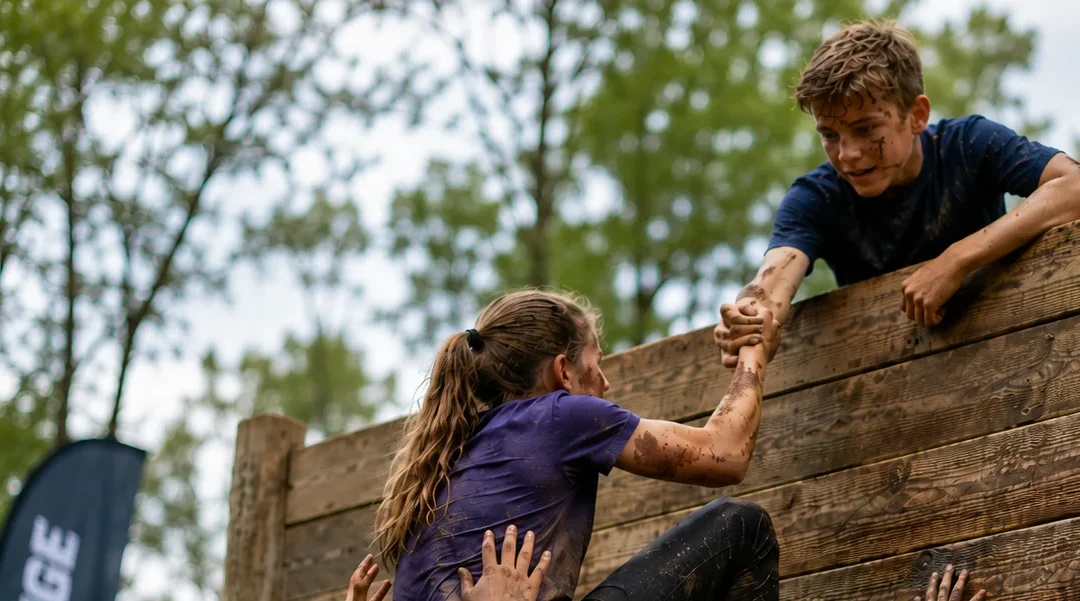
A challenge does not need to end with every child reaching the highest platform. It may mean putting on a harness, climbing the first section, asking for help, pausing to regulate emotions, or deciding to try again another day. These are not failures to be managed; they can be meaningful opportunities to build confidence, emotional control and a healthier relationship with challenge.
For parents wondering what happens when a child becomes overwhelmed on the course, read our guide: "If they don’t make it to the top, it’s okay".
Greg Brookes-Clayton is an Educational Leader and Behavioural Specialist, and Director of Learning at Challenge Academy CIC.