
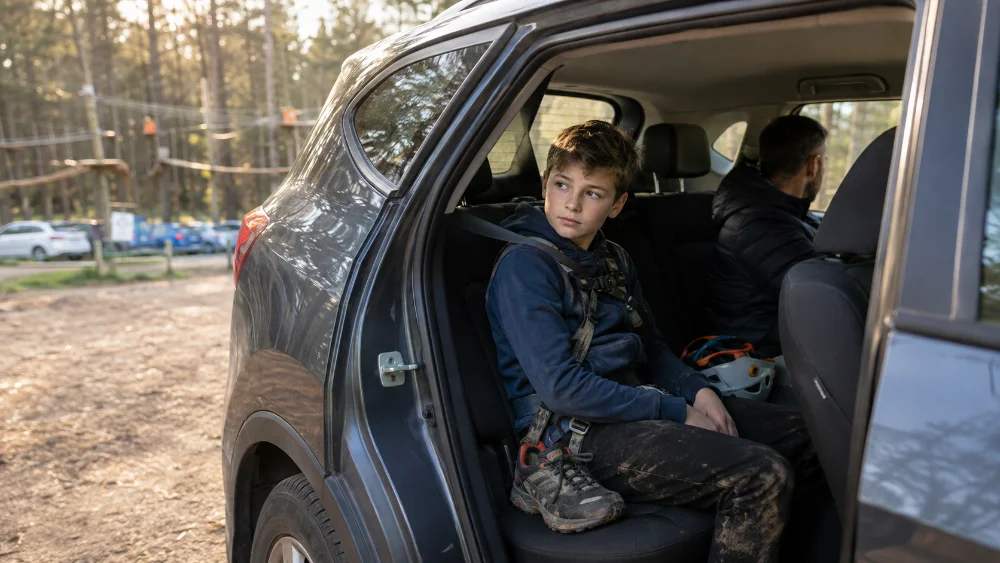
What your child is really telling you on the drive home
Something tends to happen between the car park and the first roundabout.
Your child, who twenty minutes ago was three metres up and weighing whether to take another step, is now strapped into the back seat delivering a verdict. The harness was digging in. The instructor kept going on. The boy in front was too slow. It was boring, actually. And it wasn't even that high.
You were there. You watched the whole thing. You know that none of it is quite true, and you can feel yourself getting ready to say so.
Try not to. Not yet, anyway.
The third response
Greg Brookes-Clayton, our Director of Learning, has a shorthand for what people do under real pressure, drawn from thirty-five years in classrooms, school leadership and behavioural specialism. We cry. We throw the teddies out. Or we point the finger. Tears, teddies and blame — and the useful part of his argument is that this holds true whoever you are. It describes a Year 6 pupil stuck on a sum, and it describes a governing body settling on someone to hold responsible rather than sit with an uncomfortable truth. The rooms differ. The reflex doesn't.
The drive home is where you are most likely to meet the third one.
And it is worth saying plainly, because it rarely feels this way at the time: the pointy finger is not rudeness. It isn't ingratitude, and it usually isn't lying in any sense worth worrying about. It's a repair job, carried out at speed, on a version of themselves that took a knock in front of you.
Why the harness gets the blame
Think about what your child has just done, and let's be honest that "a nice day out" rather undersells it.
They went up. Something in them said no. Other children carried on past them. And all of this happened in front of an audience that included, most significantly, you.
Now they need to get from that platform to the car with their sense of themselves intact. There are two available stories. The first is: I was frightened and everybody saw. The second is: the equipment was uncomfortable and the whole thing was overrated. The second one costs almost nothing. Of course they reach for it.
Notice, too, what gets blamed. It's nearly always something removable — the kit, the staff, the weather, another child, the queue. Those are safe targets. They can be criticised without any of it landing back on your child. What is conspicuously never blamed is the thing that actually happened, because naming that means going back to the first story.
That's not manipulation. It's a nine-year-old doing emotional triage with the tools available, roughly ninety seconds after the event.
The two things that make it worse
Correcting the record. It's the obvious move and it's the wrong one. "That's not fair, the instructor was lovely — you were just a bit scared, weren't you?" Every word of that may be accurate. What your child hears is that their cover story has been rejected and the frightening version is now the official one. So they defend the cover story harder, with more detail, and now you're having an argument about a harness.
Agreeing too enthusiastically. The opposite instinct, and just as unhelpful. "You know what, that harness did look uncomfortable." You've now co-signed it. What was a wobbly improvisation has been ratified by a parent, and it hardens into the official account of the day — the one that gets told to grandparents, and the one that will be produced next time as evidence that these places aren't much good.
The blame story is best left neither refuted nor promoted. It only needs to survive the journey home. It was never meant to last.
Three things that help instead
Let it stand. A mild "right" or "fair enough" is entirely sufficient. You are not endorsing it and you are not challenging it. You're letting the pressure come off, which is the only thing that needs to happen in the next ten minutes.
Ask about texture, not outcome. Outcome questions — how far did you get, did you finish, why did you stop — put them straight back on the platform. Sensory ones don't. What did the rope bridge feel like underfoot? Was it noisy up there? Could you see the car park? These are answerable without any admission attached, and children very often talk their way round to the real thing while describing something else entirely.
Wait. This is the one that requires the most discipline and repays it best. The truthful version usually turns up between one and three days later, sideways, at bedtime or in the back of the car on a completely unrelated journey. "That bit where it wobbled was actually quite scary." No prompt, no ceremony. If you have spent the intervening days quietly not arguing about the harness, that sentence is available to them. If you won the argument on day one, it isn't.
One caveat worth stating
None of this means every complaint is a cover story, and we would much rather you told us than sat on it.
There's a rough test. Protective blame is sweeping, arrives immediately after the disappointment, and thins out within a couple of days. A genuine complaint tends to be specific, consistent, and about how someone was treated — and it does not fade. If what your child is describing sounds like the second kind, please ring us. That's a different conversation and we want to have it.
Where the finger stops pointing
The blame reflex isn't a character flaw to be trained out. It's what shows up when getting something wrong feels like a judgement on who you are, rather than an ordinary feature of learning something hard. Which means the question isn't how to stop a child blaming the harness. It's how to build enough experience of stopping, wobbling, changing their mind and coming through it unscathed that the harness no longer needs blaming.
That's the whole point of Challenge by Choice, and it's why nobody at Baggeridge is ever made to reach the top. A child who can say "I got to the second platform and that was enough for today" — flatly, without a story attached — has arrived somewhere genuinely worth arriving at. Most children get there eventually. Almost none of them get there in the car park.
So if today's version is that it wasn't even that high, let it be. Ask what the rope felt like. See what turns up on Thursday.